Manure Inputs
Methods 5.0
Introduction
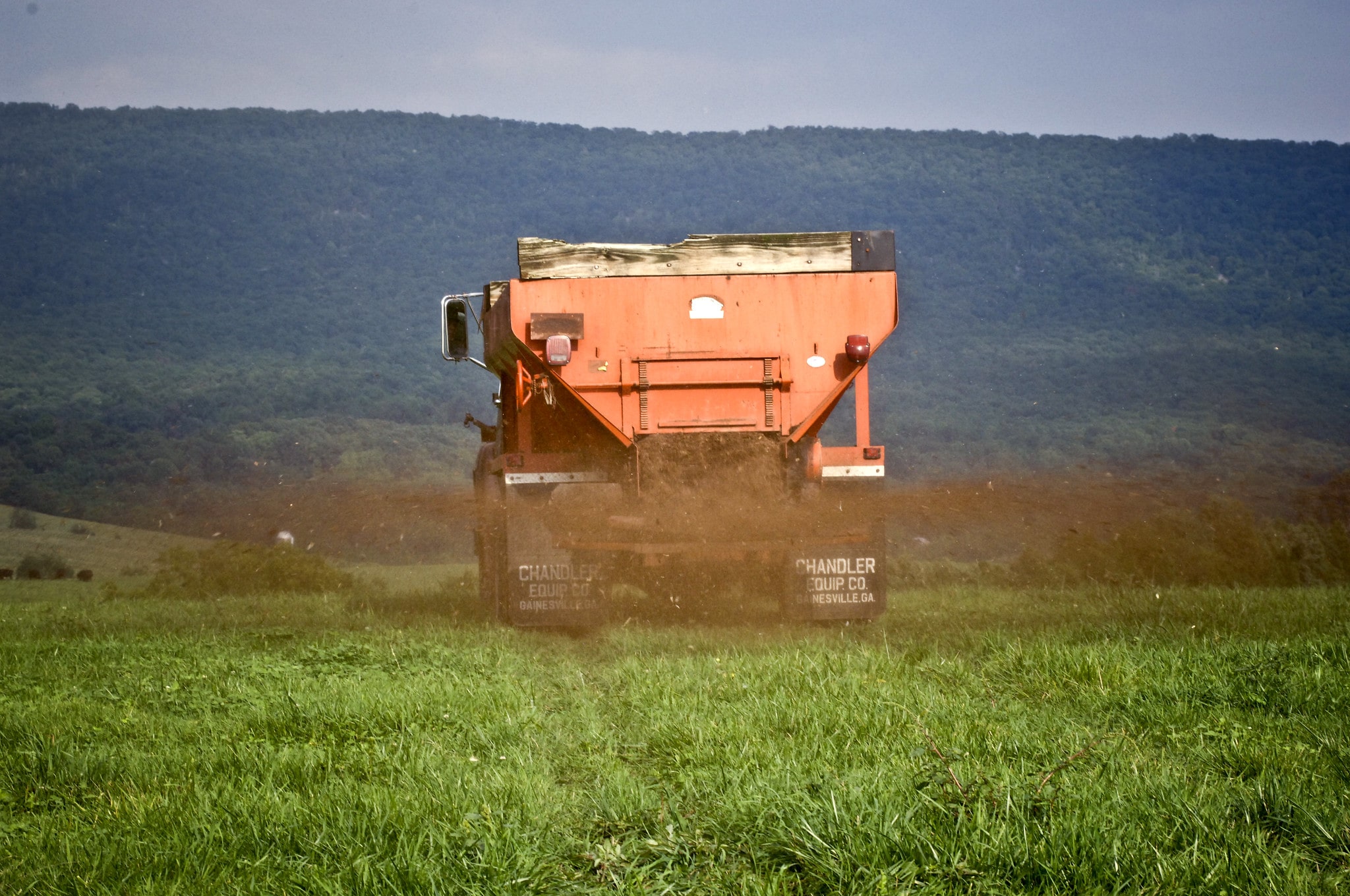
Applying animal manure to farm soils can improve soil fertility and health by supplying nitrogen (N), phosphorus (P), and organic matter. The Fieldprint Calculator collects manure information related to the content, transportation, and application of manure. This data is used to calculate results for energy and GHG emissions related to manure application, effects on soil processes and soil organic carbon, and impacts to water quality.
Manure is a nutrient application activity option in the Fieldprint Calculator for all crops, though applications are most likely to occur on fields near livestock operations or at integrated crop/livestock operations. Access to manure sources and forms varies regionally (Flynn et al. 2023; Spiegal et al. 2020).
Inputs
Those applying manure will likely know the manure content based on lab analysis. Manure analysis reports (example) may include: source, form, % solids, total N, inorganic N (NH4), and total P2O5, and sometimes total C. In the Fieldprint Calculator, manure content inputs are “as-applied”, which is also referred to as “as-sampled” or “as-received” (by the lab). The Fieldprint Calculator v5 queries a back-end dataset derived from ManureDB to automatically choose default values for manure content based on the field location, manure source, and manure type. These default values cannot be modified by the user at this time, but future platform development includes plans to introduce this capability. National content values are used only in cases where regional values are missing.
Inputs
| Input | Value | Units | Symbol |
|---|---|---|---|
| Manure application date | User entry | ||
| Manure source | User selection | Beef, Dairy, Poultry, or Swine | |
| Manure type (form) | User selection | Liquid, slurry, semi-solid, or solid. | |
| Nutrient content1 | Back-end dataset derived from ManureDB | %, lbs/ton, lbs/1000-gal | |
| Field area | Defined by user-entered field boundary | ac | \(A\) |
| Application rate | User entry | gal ac-1 ton ac-1 |
\(R\) |
| Application mode | User selection | ||
| Distance transported | Default based on manure type | mi | \(d\) |
| Transportation energy constant2 | 10,416 | BTU ton-1 mi-1 | \(C_{mt}\) |
| Density factor of liquid manures3 | 8.34 | lb gal-1 | \(\rho\) |
1 as-applied/as-sampled/as-received
2 Source: 2023 ANL-GREET Feedstock CI Calculator.
3 Used for liquid/slurry manures (Wilson et al. 2022)
Application date
The dates of manure applications are connected to soil biogeochemical processes modeled by SWAT+.
Manure Source
The user selects from a short list of the most common animal manure sources: beef, dairy, poultry, or swine. These classes are generalized4. For example, poultry includes all classes of chickens and turkeys, without distinguishing between broilers or layers or pullets and so on.
4 More granularity can be added in future versions of the platform pending support.
Manure Type
The user selects from a short list of four manure types or forms: liquid, slurry, semi-solid, or solid. The types are characterized by their moisture/solids content as shown in Table 1. If the user has access to the manure lab analysis, the percent of total solids (also equal to 100 - % moisture) can guide which manure type to select.
| Designation | Total Solids (as-received) |
|---|---|
| Liquid | 1-4 % |
| Slurry | 4-10 % |
| Semi-Solid | 10-20 % |
| Solid | >20 % |
Source: Wilson et al. (2022) Appendix A.
If the user does not know the percent solids in the applied manure, the user should use their best judgment when selecting a manure type. For example, poultry litter or beef manure would usually be characterized as semi-solid or solid, whereas dairy cow manure might be a slurry, and the liquid from the top of a swine manure lagoon would most likely be liquid.
In the Fieldprint Calculator currently, the manure source and type selections do not affect manure-related calculations like transportation energy (i.e., a ton of liquid swine manure weighs as much as a ton of solid poultry litter). The Calculator uses the user-provided manure source and type information to select a reasonable default content value from data derived and aggregated from the ManureDB (Bormann et al. 2024). See Table 2 for a sample of such data.
Rate and Amount of manure applied
If manure type = Semi-solid or Solid (solids > 10%), then the Calculator sets the units of application to \(ton\ ac^{-1}\). The field acres multiplied by the rate gives the total tons of manure applied (\(m\)) .
\[ m = A\ R \]
If manure type = Liquid or Slurry (solids < 10%), then the Calculator sets the units of application to \(gal\ ac^{-1}\). The volume applied will be converted to \(ton\) (and then \(kg\)) in the back-end by multiplying by a density factor and dividing by 2000 \(lb\ ton^{-1}\). The density factor of 8.34 \(lb\ gal^{-1}\) applies mostly to manure with less than 5% solids (Wilson et al. 2022), though it can be used for slurry up to 10% solids (Bormann et al. 2024).
\[ m =\frac{A\ R\ \rho}{2000} \]
where units of \(R\) = gal ac-1
Manure application mode
The user will specify if the manure was applied by:
injection with high disturbance
injection with low disturbance
spreading (on the field surface)
This information is connected to the Platform’s integration with the CR-LMOD operation database (Carlson et al. 2018) and affects the energy, emissions, and soil disturbance associated with applying the manure in the field.
Manure transportation distance
The manure transportation distance is the distance (mi) from the manure source to the edge of the field where it was applied. This is used with a factor from GREET FD-CIC with units of energy per ton per mile to calculate energy and emissions related to manure transportation. Manure transport distances vary across the United States and by manure source (Spiegal et al. 2020; Dell et al. 2022; Bryant et al. 2022). However, the Fieldprint Calculator limits additional user input by using the following distances as defaults for manure transportation:
3 miles if the manure form is liquid or slurry.
30 miles if the manure form is semi-solid or solid.
We are open to collaboration to develop regional and/or source-specific default distances for manure transportation.
Tables
Sample of Manure Content Data
| manure_region | manure_source | manure_type | pct_solids | total_c | total_n | total_p2o5 |
|---|---|---|---|---|---|---|
| Northeast | Dairy | Semi-solid | 14.60 | 135.0 | 7.940 | 3.330 |
| Southeast | Dairy | Slurry | 6.29 | 181.0 | 8.520 | 5.440 |
| Northeast | Dairy | Slurry | 6.45 | 227.0 | 22.800 | 9.000 |
| Midwest | Beef | Semi-solid | 13.30 | 128.0 | 13.400 | 7.000 |
| Midwest | Swine | Liquid | 1.99 | 48.9 | 25.900 | 10.000 |
| Southeast | Dairy | Liquid | 1.27 | 51.7 | 0.614 | 0.992 |